

The 1% Rule in Memphis: Every Cheap House Clears It, Almost No Expensive One Does
We matched 458 Memphis houses to their own deed and their own rent listing. You pay 3 times more at the top and collect 1.5 times the rent.

Every house in Memphis has two numbers attached to it. What somebody paid for it, which is filed at the Shelby County Register of Deeds. And what it asks in rent, which shows up on a listing site. Those two numbers almost never get put in the same row, because they live in different places and nobody is holding both.
We hold both. We read the deed roll and we check every Memphis rental listing every night. So we can do something simple that turns out to be rare: take one house, find what it actually sold for, and find what that same house actually asks in rent.
Matching 458 three-bedroom Memphis houses that way, as of August 2026, produced a result that is more lopsided than we expected. These figures update as the deed roll and the listing sweep do.
You pay 3 times more and collect 1.5 times the rent
Sort those 458 houses into four equal groups by what the buyer paid. The typical house in the cheapest quarter cost $78,000. In the most expensive quarter it cost $234,950. That is three times the money.
The rent does not follow. The cheapest quarter asks $1,170 a month. The most expensive quarter asks $1,750. That is 1.5 times.
Price triples. Rent goes up by half.
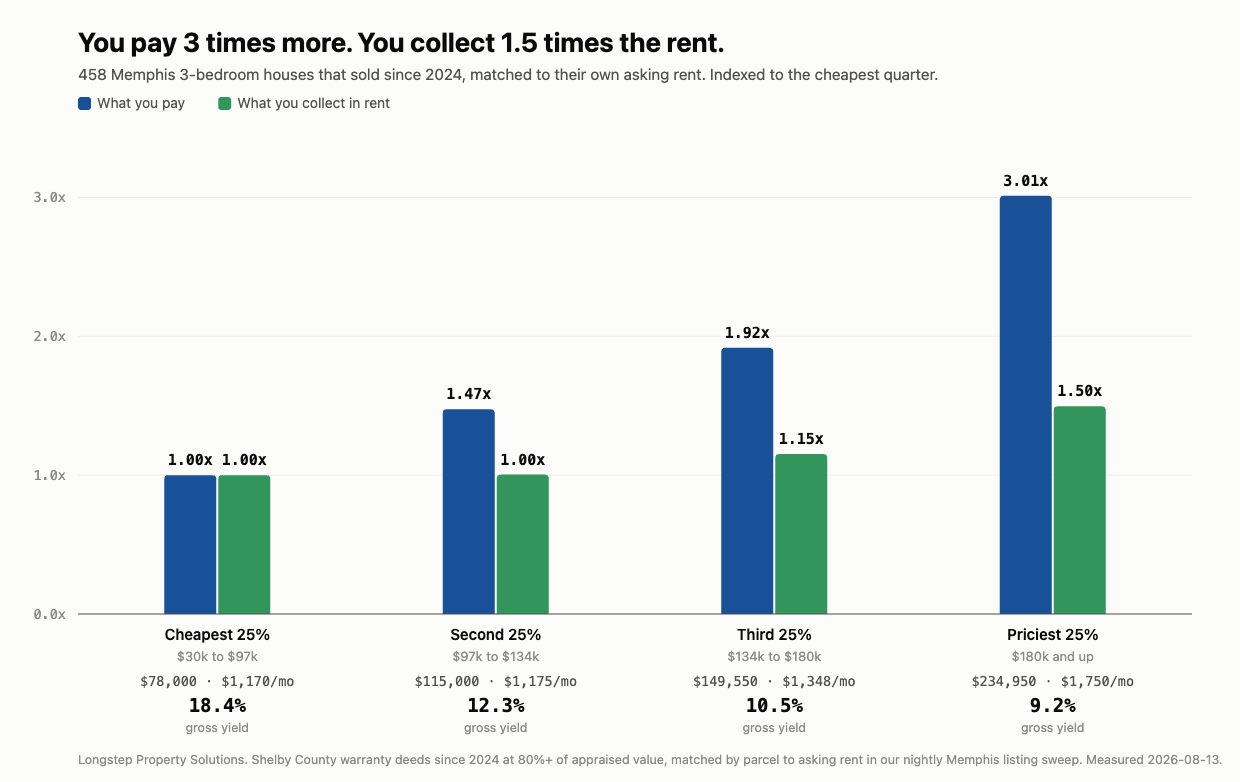
| What the buyer paid | Price range | Typical price paid | Typical asking rent | Gross yield | Clears the 1% rule |
|---|---|---|---|---|---|
| Cheapest 25% | $30,000 to $97,000 | $78,000 | $1,170 | 18.4% | 100% |
| Second 25% | $97,050 to $133,900 | $115,000 | $1,175 | 12.3% | 55% |
| Third 25% | $134,400 to $180,000 | $149,550 | $1,348 | 10.5% | 23% |
| Priciest 25% | $180,000 and up | $234,950 | $1,750 | 9.2% | 1% |
Every figure in that table is a median, including the yield. An earlier version of it mixed averages for price and rent with a median yield, which is how the top group briefly looked like 3.6 times the money instead of 3 times: one house in it sold for $1.1 million and dragged the mean.
Gross yield is a year of asking rent divided by what the buyer paid. It is the crudest possible measure and it ignores everything that happens after closing, which we will get to. But as a starting point it is the number most investors are actually asking about.
The 1% rule is not dead here. It is a price band.
The old investor shorthand says a rental should ask at least 1% of its purchase price every month. A $100,000 house should rent for $1,000. Most of the country stopped clearing that years ago, and you can find a hundred posts declaring the rule obsolete.
In Memphis it is alive, and it is alive in a very specific place.
Every single house in the cheapest quarter clears it. One percent of the houses in the priciest quarter do.
That is not a market observation. That is a purchase decision. Two investors buying in the same city in the same year, both making a sensible-looking buy, end up on opposite sides of a rule of thumb depending entirely on what they were willing to spend.
The part that eats into it
Now the honest half, because a gross yield that good would already be arbitraged away if it were free money.
Cheap Memphis houses take longer to rent. Running the same listing data with survival math, a three-bedroom asking under $1,100 takes a median of 47 days to come off the market. One asking $1,100 to $1,499 takes 37 days. One asking $1,500 or more takes 36 days. The method behind those figures, and why the naive version understates them by ten days or more, is in how long Memphis rentals take to lease.
So the cheapest band carries about eleven extra vacant days on every turn, on a smaller rent. That is roughly a third of a month of rent given back each time a tenant leaves, and turns tend to come more often at the bottom of the market than the top.
### What about renovation cost?
This is the first question anyone serious will ask, and we cannot answer it directly. A deed records what somebody paid. It does not record what they then spent on the roof.
We went looking. Building permits filed with the city would be the obvious source, and not one of the 110 permits pulled on these houses after their sale carries a job valuation. The valuation field is essentially empty before 2026. A rehab estimate does exist in our own flip data, and it turned out to be worthless for this: it is calculated as 70% of the later resale price minus the purchase price, which is a wholesaler rule of thumb run backwards, not a measurement of anything anyone spent.
So instead of guessing, here is the arithmetic in the other direction. Holding the rent constant, this is what a buyer in the cheapest quarter would have to spend on the house before its advantage disappears:
| Renovation spend on a typical cheap-quarter house | What it does to the return |
|---|---|
| $37,835 | drops it to the second quarter's 12.3% |
| $40,750 | it stops clearing the 1% rule |
| $57,714 | drops it to the third quarter's 10.5% |
| $76,728 | drops it all the way to the priciest quarter's 9.2% |
Read that as the real decision. A cosmetic turn does not erase the gap. A $40,000 job erases most of it. A gut renovation erases all of it and then some. If you are buying at the bottom of this market, the renovation estimate is not a detail attached to the deal, it is the deal.
Taxes, insurance, delinquency and management sit on top of all of it too, and none of them scale down as fast as the purchase price does.
The honest summary is that the cheap end genuinely produces more rent per dollar spent, and it also produces more of the work and more of the risk.
Two numbers we threw out, and why
This is the part we would rather show than hide, because both of these would have made a better headline and both were wrong.
The first version of this said the cheapest houses yield 41%. That was a data artifact. A deed record has a sale price on it, but not everything filed as a deed is a sale. Transfers between family members, transfers into an owner's own holding company, and cleanup filings all carry a price that has nothing to do with market value. Checked against the county's own appraised value, the deed roll is sound in aggregate: the median sale in our set came in at 0.97 times the county's appraisal. But 51 records landed at under half of it, and those carried a fake 39% median yield that dragged the whole picture up. Every figure above uses only sales at 80% or more of appraised value.
The second version tried to measure how quickly investors put a house on the rental market after buying it. We had to throw that out entirely. Our nightly sweep of Memphis listings started in May 2026, so the date we first saw a listing is not the date it was listed, it is the date we showed up. Anything built on it would have measured our own observation window and called it a market behavior. We have made that exact mistake before on this site and corrected it publicly, so it gets caught faster now.
What we would actually do with this
If you are buying a Memphis rental, the return is decided at the closing table and not at lease-up. Rent across these four groups moves within a few hundred dollars. Price moves by more than $150,000. Whatever you are optimizing, the purchase price is the lever with almost all the travel in it. It also helps to know what the rent side is doing before you underwrite it: right now Memphis landlords are cutting asking rents far more often than raising them, which we track in rent cuts versus raises, and the going rate by size sits in Memphis rent by bedroom.
If you already own one, the useful question is not what your house would rent for. It is what it would rent for against what you paid, which is a number nobody sends you and which decides whether you are in the top group or the bottom one. If you are choosing where to buy next, the best Memphis neighborhoods for rentals breaks the same tradeoff down by area.
And if the cheap end tempts you, price the eleven extra vacant days and the condition risk before you decide it is free yield. Sometimes it still is. It is just never as free as the gross number makes it look.
Quick answers
Does the 1% rule still work in Memphis?
Yes, but only in a band. Matching 458 Memphis three-bedroom houses to their own recorded sale price and their own asking rent, every house in the cheapest quarter of purchase prices clears the 1% rule and about 1% of the houses in the priciest quarter do. It is less a market condition than a consequence of what you were willing to pay.
What is a typical gross rental yield in Memphis?
Across 458 matched three-bedroom houses that sold since 2024 at 80% or more of the county appraised value, the median gross yield is about 11%. It runs 18.4% in the cheapest quarter of purchase prices and 9.2% in the priciest. Gross yield is a year of asking rent divided by the purchase price and excludes renovation, taxes, insurance, vacancy and management. Renovation matters most: about $40,000 of work erases the cheapest quarter advantage entirely.
Do cheaper Memphis rentals take longer to lease?
Yes. Using survival math on our nightly listing sweep, a three-bedroom asking under $1,100 takes a median of 47 days to come off the market, one asking $1,100 to $1,499 takes 37 days, and one asking $1,500 or more takes 36 days. The cheapest band carries about eleven extra vacant days per turn on a smaller rent.
How can you tell what a Memphis rental actually sold for?
Sale prices are filed publicly at the Shelby County Register of Deeds. The caution is that not everything filed as a deed is a sale: transfers between family members or into an owner holding company carry prices unrelated to market value. Checking against the county appraised value screens most of them out, and our median sale came in at 0.97 times the appraisal.
Does the Memphis 1% rule survive renovation costs?
Partly, and it depends entirely on the size of the job. A deed records what a buyer paid, not what they spent afterward, and building permits in Memphis almost never carry a job valuation, so this cannot be measured directly. Working backward instead: on a typical house in the cheapest quarter, about $37,800 of renovation drops it to the second quarter return, about $40,750 stops it clearing the 1% rule, and about $76,700 drops it to the priciest quarter 9.2%. A cosmetic turn does not erase the gap. A gut renovation does.
Run the numbers on your address
Enter your address for a live, comp-backed estimate built from real Memphis data. Free, no obligation to anything.