

One in Three Memphis Evictions Ends Without the Landlord Getting Possession
Of 8,883 Shelby County eviction cases that reached a disposition, one in three did not end with the landlord getting possession. The plaintiff ended most of them.

We pull Shelby County detainer filings every day. As of August 2026, the window from February 2 to June 30, 2026 holds 10,481 filings from 1,820 different plaintiffs. 8,883 have reached a disposition.
Here is how those ended.
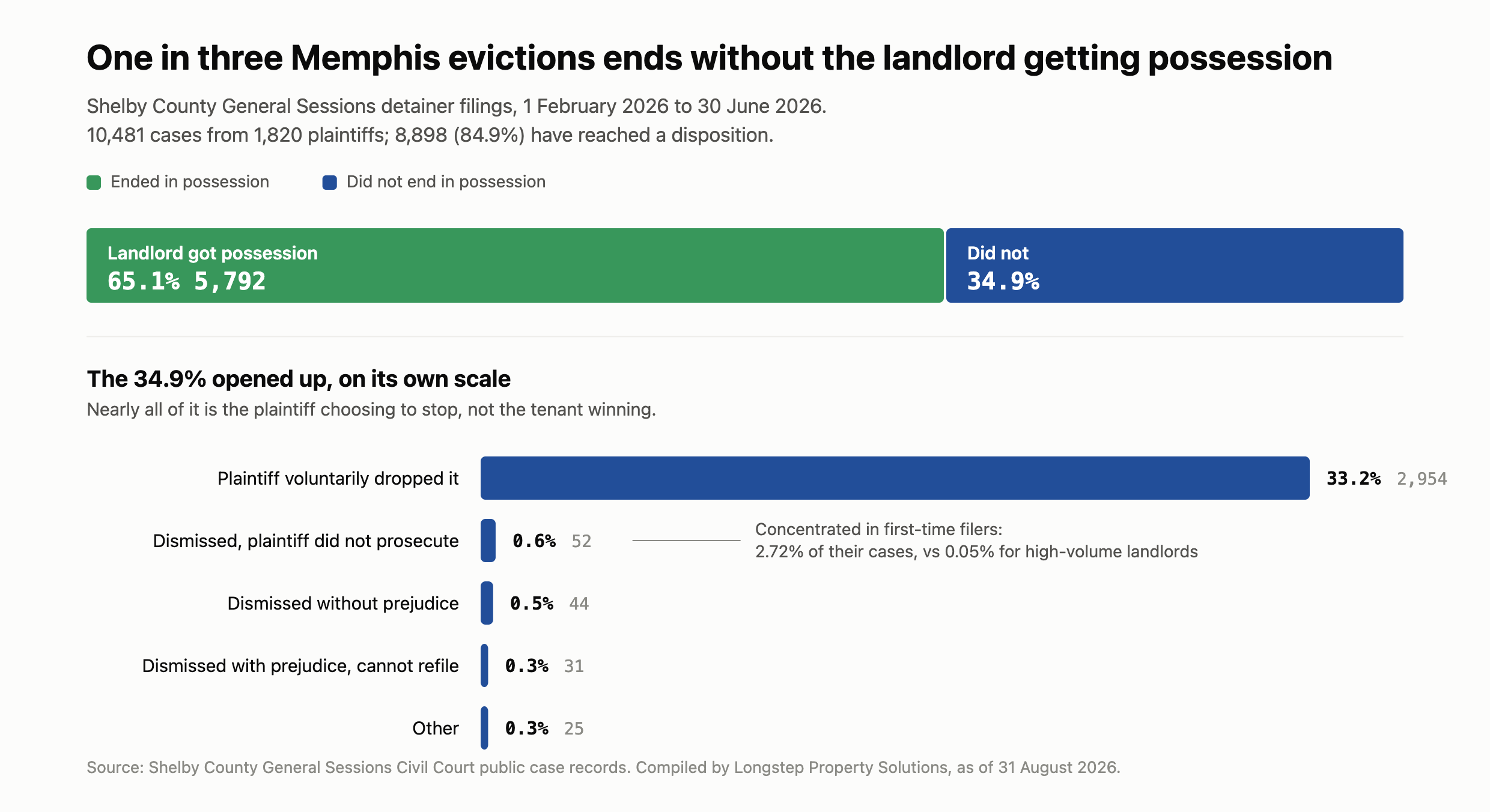
| Outcome | Cases | Share |
|---|---|---|
| Landlord got possession | 5,782 | 65.1% |
| Plaintiff voluntarily dropped it | 2,949 | 33.2% |
| Dismissed, plaintiff did not prosecute | 52 | 0.6% |
| Dismissed without prejudice | 44 | 0.5% |
| Other | 39 | 0.4% |
| Dismissed with prejudice, cannot refile | 17 | 0.2% |
The headline is not the first row. It is that roughly one in three cases that reached a decision did not end with the landlord getting the property back, and in almost every one of those the case was ended by the landlord's own side rather than defeated by the tenant.
Most Memphis evictions that end without possession are ended by the plaintiff
2,949 cases were voluntarily dropped. That is not a loss in court. Somebody chose to stop, and usually for a good reason: the tenant paid, the tenant left, a payment plan held. A voluntary dismissal is often the system working.
The 52 in the row below it carry a different code. Dismissed for want of prosecution means the court ended the case because the side that filed it did not move it forward. Nobody appeared, or nobody did the next thing. It shows up in about one of every 170 disposed cases.
It is tempting to read that row as landlords losing cases they should have won. Mostly it is not. If a tenant pays and the case stops mattering, nobody refiles. If a landlord fumbles a case they still want, they file again on the same tenant at the same address. So we measured the refiles: want of prosecution comes back at 14.3 percent, and a voluntary dismissal, the code you use when you are deliberately dropping it, comes back at 10.2 percent. Across the 42 cases with enough runway to observe, that gap is noise. Six in seven never come back at all, which is what a case that stopped mattering looks like.
What does separate that row is who files it. Landlords who filed a single case all year end in want of prosecution on 3.7 percent of their disposed cases. Landlords who filed a hundred or more: 0.04 percent. Ninety times lower. It is a first-timer outcome, not a market-wide failure, and the difference is experience with the process rather than anything about the tenant.
Nobody tells you
The one in seven that does come back is where the money goes, and nothing tells you which one you are in.
When a case is dismissed for want of prosecution, the property does not change. The resident stays. No writ issues. The docket updates and that is the entire notification. If you are an out of state owner, or an owner whose manager files evictions on your behalf, the first signal that anything went wrong is usually that nothing is happening, and "nothing is happening" looks identical to a case that is proceeding normally. That blind spot is one of the recurring costs in our guide to investing in Memphis from out of state.
We watched exactly this play out. An owner had a judgment entered on August 11 and understood he had won. He spent the next three weeks asking his manager when the writ would be served. The case had actually been dismissed on August 11 because his side did not prosecute it. Nobody had told him, and he only learned when the warrant itself was read.
Then it gets worse in a quiet way. Dismissed without prejudice means you can refile, and refiling means starting over: a new warrant, new service on the resident, a new hearing date. Every day of that second run is another day of an occupied, unpaid unit. The Memphis Eviction Courthouse Decoder has the filing fees and the realistic timing for each step of that second run.
Two things most Memphis owners have backwards
Both of these came out of the same case.
The writ does not issue automatically. Winning does not dispatch anybody. The property owner has to file for the Writ of Possession at the Clerk's Office and pay a fee, and the Clerk issues it from there. A won case with no writ request sits still indefinitely. Most Memphis eviction guidance skips this step entirely, which is why so many owners end up waiting on a sheriff nobody has asked for. Our Memphis eviction process guide walks the full sequence from notice through writ.
An appeal will not appear on your case. Either side can appeal within ten days, and an appeal moves the matter to Circuit Court for a fresh hearing. It does not show up as activity on the General Sessions case, which is why owners check, find nothing, and assume no appeal happened.
What to do about it
Call the General Sessions Civil Court Clerk at (901) 222-3400 with your case number and ask two questions: was an appeal filed, and has a Writ of Possession been requested. The second one usually explains the delay. We wrote a fuller walkthrough at how to check the status of your Memphis eviction.
If somebody files evictions on your behalf, ask them for the disposition and the writ request date in writing rather than a status update. Those are two specific facts with dates attached, and they are harder to answer vaguely.
How we know this
These are Shelby County General Sessions FED filings, pulled daily from the court's public case system and matched to the parcel where we can. The window is February 2 to June 30, 2026.
Two limits worth stating. Five months is not a year, so treat the percentages as a read on this window rather than a settled Memphis average. And about 15 percent of the filings in it were still open when we counted, which tilts the mix slightly toward cases that finish quickly. We quote this window rather than a more recent one because nearly all of it has finished, and we will publish a longer baseline as the record fills in behind it.
For how often filings happen in the first place, by area, see eviction filings per 100 rental houses by ZIP code.
We are not attorneys and none of this is legal advice.
Quick answers
What share of Memphis evictions end with the landlord getting possession?
Of 8,883 Shelby County detainer cases that reached a disposition between February 2 and June 30, 2026, 65.1 percent ended with the landlord getting possession. The remaining third mostly ended because the plaintiff dropped the case or failed to prosecute it, not because the tenant won.
What does dismissed for want of prosecution mean on an eviction case?
It means the court dismissed the case because the side that filed it did not move it forward, usually by not appearing. It happened in about 0.6 percent of disposed Shelby County cases in our window. The dismissal is without prejudice, so the case can be refiled, but the process starts over.
Will I be told if my Memphis eviction is dismissed?
Not automatically. The docket updates and that is the notification. Nothing changes at the property, no writ issues, and the resident stays. For an owner whose manager or attorney files on their behalf, a dismissed case and a case proceeding normally look identical from the outside.
Does winning an eviction in Memphis mean the sheriff comes automatically?
No. The property owner has to file for a Writ of Possession at the Clerk’s Office and pay a filing fee before anyone is dispatched. A won case with no writ request will sit indefinitely.
Run the numbers on your address
Enter your address for a live, comp-backed estimate built from real Memphis data. Free, no obligation to anything.